

Getting published once doesn’t guarantee you’ll get published again.
You can write an excellent book. You can publish with a major house. And your next manuscript can still get rejected.
Not because the writing isn’t there — you’ve already proven you’ve got the chops — but because publishing is an incredibly subjective and ever-changing business.
So fall in love with writing itself.
The authors who make it aren’t the ones chasing bestseller lists or trying to write toward whatever’s trending. They’re the ones who sit down at their desk, forget about the industry for a few hours, and remember why they started telling stories in the first place.
Because the only thing in publishing you can actually control is the words on the page.
In today’s interview, author and editor Elayne Audrey Becker shares the hardest truth she’s faced since her debut, how patience landed her four offers of representation, and the mindset shift that’s keeping her creative flame alive.
OUR SPECIAL GUEST TODAY IS…
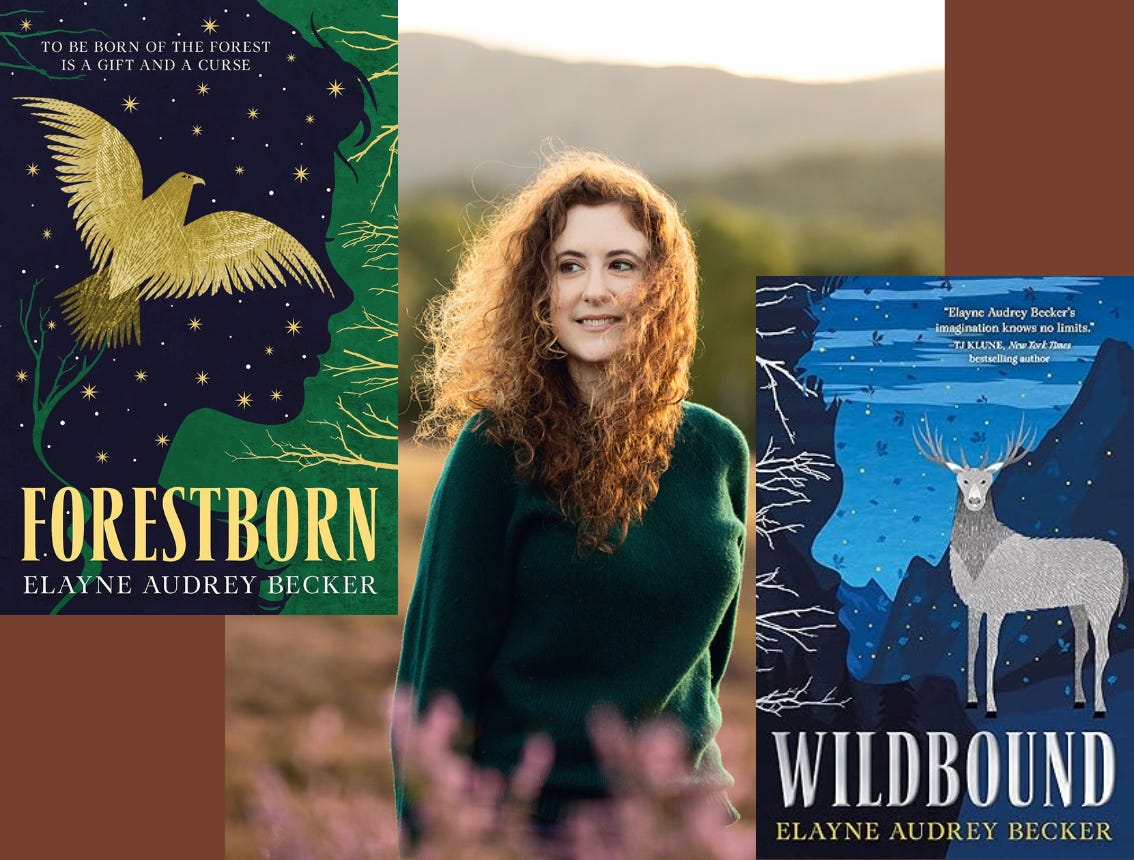
Elayne Audrey Becker
Author and Editor
Her novels FORESTBORN and WILDBOUND are available for purchase now!
What’s been the toughest moment in your publishing journey, and how did you get through it?
After I received a contract for the Forestborn duology, a not insignificant part of me thought, “This is it. My author career has officially launched.” It wasn’t that I expected the books to become bestsellers out of the gate; having worked in publishing for so many years, I knew well how rare it was to have a debut break out and attract the attention of the masses. (I knew, too, that when a debut does “hit the list,” it is usually due to the publisher’s marketing push more so than the content or quality of the book itself.) Rather, I thought, “Okay, I’ve auditioned for this job and proven myself capable of doing it.” I thought it would be easier to secure another contract for a new book, now that my writing had passed the test.
Working as a novelist, however, turns out to be a role you have to audition for over and over again. In the three years since Wildbound was published, I have struggled to secure my next contract. Not because my manuscripts are bad, not because the quality of my writing isn’t there, but because publishing is, as my agent Tia Ikemoto puts it, “A moving target market based entirely on subjective opinions,” and my books have not fallen into whatever profitable trend happened to be dominating the fantasy market at the time of submission.
I won’t lie. To work on a novel for so many months—years—only to have the door shut in your face over and over is difficult. Demoralizing. Heartbreaking. But writers like myself don’t get into this business because we’re looking to make money. We write because we love it. Because we must. Because the stories taking shape in the corners of our minds demand to be told.
Reconnecting with that creative joy, nurturing its tiny flame, is my mission now. Here is what I tell myself: You can write an excellent book, and after all is said and done, it might be published. Or, you can not write the book, and then it definitely won’t be published. Always, I choose to take the option that comes with a chance. And as I continue drafting my newest novel, I don’t sit down at my desk and think about the publishing industry. I sit down and write because I love it. Because I must.
How did you get your literary agent? What was the querying process like for you?
I queried a relatively small number of agents—about twenty in total—over the course of approximately eight months. I didn’t throw spaghetti at the wall; I was very intentional in deciding to whom I’d reach out, and I didn’t rush the process, choosing instead to gauge the initial response to my manuscript and let full requests play out. The waiting was hard, as were the inevitable rejections I received along the way. But I continued to believe in the quality of my work, and I carried on.
Around the eight-month mark, I sent out a query to another agent on my list, and less than a week later, I had received an offer of representation. A dream come true! In the end, I received four offers of representation and accepted the one that felt right in my gut, and that blossomed into a wonderful partnership. Eight years later, I have since switched agents within CAA to someone who works more closely with the kind of fiction I aim to write, and I am so thrilled to be there!
What’s one thing you do (creatively, mentally, or physically) that helps you stay in it when writing gets hard?
Changing up my space makes an enormous difference when I’m in a writing rut. I go to my favorite coffee shop, treat myself to an oat milk latte and perhaps a pastry, and choose a table where I can feel my creativity surfacing. Often, this is enough to do the trick and kickstart productivity.
When that fails, however, I put the book down entirely and take a break. Stepping away from a manuscript for a couple of weeks can feel really counterproductive, but by now, I’ve realized the opposite is true. Doing so allows me to return to the manuscript with fresh eyes and a recharged creative battery.
Are you querying this year?
Preorder my querying guide written with the creator of QueryTracker!

What’s a myth about publishing or being an author that you wish more people understood?
That the quality of a book determines whether or not it sells, and that authors have a large degree of input in how their books get packaged and marketed.
In reality, authors have next to no control in the publishing process. That relinquishing of control begins as early as submitting one’s manuscript to publishers. You can and should make your book the very best it can be, but at the end of the day, market positioning and commercial appeal are two of the biggest determinants in whether or not a publisher offers on a book—and while you should be cognizant of the market in which you’re aiming to write, you cannot control what will be popular at the time your book happens to go out on sub. This can be thoroughly depressing to creatives who just want to tell good stories because they are good. But it is the reality. Publishing is a business, and its leadership wants to make money.
Then, if you manage to land a contract and a good editor, they may include you in various parts of the decision-making that happens on the 18-24 month road to publication. But even with the very best and most inclusive editors, 95% of meetings about your book will still happen in-house, outside the author’s sphere of awareness; authors do not control the cover art given to their books, the manner in which the books are typeset, the degree to which their books are pushed by the publisher. When I worked as an editor at a major publisher, I was privy to that 95%. As an author, I wasn’t, and boy was that hard at times! Our books are our babies, the characters real to us, and we want to ensure they’re taken care of properly.
Ultimately, though, the only thing in publishing that writers can control is the words on the page. So we just have to focus on making those as good as we can make them.
Ready for feedback that takes your story to the next level?
“I have greatly benefitted from my collaboration with Alyssa; I would not be where I am today without her! Her developmental ideas and vision for my novel taught me so much and helped to elevate my work in highly effective ways. Her editorial fingerprint is evident in the final result—a novel on bookshelves nationwide.”
—Jill Beissel, author of Glitter and Gold
What’s the best piece of feedback you ever received? How did it change your story?
One of the best things I’ve ever done for my writing is to learn to take feedback, period. When I was younger, I used to balk at the prospect of being told to change things about my stories. I had trouble separating the work from the person, and so took critical feedback on my work as personal insults.
Now, I love receiving critical feedback on my manuscripts. I crave it. As someone who works as both an author and an editor, I know very well how important it is to receive an outsider’s perspective on one’s novel. As writers, after picking away at a manuscript over and over and over again, at a certain point, we lose the ability to actually see what is on the page. We become blind to our books. Because of this, it’s impossible to maximize our story’s potential and make it the best it can be without gaining feedback from a trusted source.
You don’t want to make changes based on just any person’s opinion, of course. I don’t take critical feedback from “randos” on the internet who have negative things to say about my books—why would I? I know nothing about their professional background in writing or editing. I do, however, immensely value feedback from editors, my agent, and writer friends. The day I receive feedback can sting, but my books are always, always, better once I implement their notes.
What do you do to stay true to yourself in your writing?
This is something I’m in the process of figuring out right now. To make a very long story short, what I keep coming back to is this reminder: “Do not write to sell. Write because you love it.”
Nowadays, when I sit down to work on my newest novel, I try to divorce thoughts of my book from thoughts of publishing as much as possible. I try, instead, to simply sink into the joy that writing and telling stories brings me. I try to lean into the fun of it all. And when I do that—when I can manage to forget about the industry and marketability and sales tracks for a brief time—my writing comes out better, and I am happier. So I will continue down this path.
ICYMI…this week on YouTube, I share the signs that indicate you’re querying or self-publishing too soon (and setting yourself up to fail).

Great advice.
I write for the joy of writing. It never even occurred to me that I should publish until my beta readers and a local writers group here recommended I pursue it. My intent was just to write for myself and closest friends, making copies a stocking stuffer.
Thanks for this and all the information you share with us. I'll be querying within the next few weeks, and your content is a huge part of my preparation.