

Being a writer doesn’t mean quitting your day job.
Somewhere along the way, a lot of aspiring authors picked up the idea that “real” writers write full-time — that if you’re serious about your craft, you should be doing it as your day job. But that’s not how most published authors actually live.
The vast majority are working other jobs, raising kids, and writing whenever they find a moment to spare.
Reframe writing as a practice, not a profession.
When you stop chasing the fantasy of writing as your only work, you start building sustainable habits. You protect the hours you do have. You give yourself the mental space to create.
Most books aren’t written in perfect conditions, but in a bunch of in-between moments added up.
In today’s interview, author Rowan Beaird shares the publishing myth she wishes every aspiring author understood, how she protects sacred writing time in a busy life, and the low-tech writing tool that changed her creative process.
OUR SPECIAL GUEST TODAY IS…
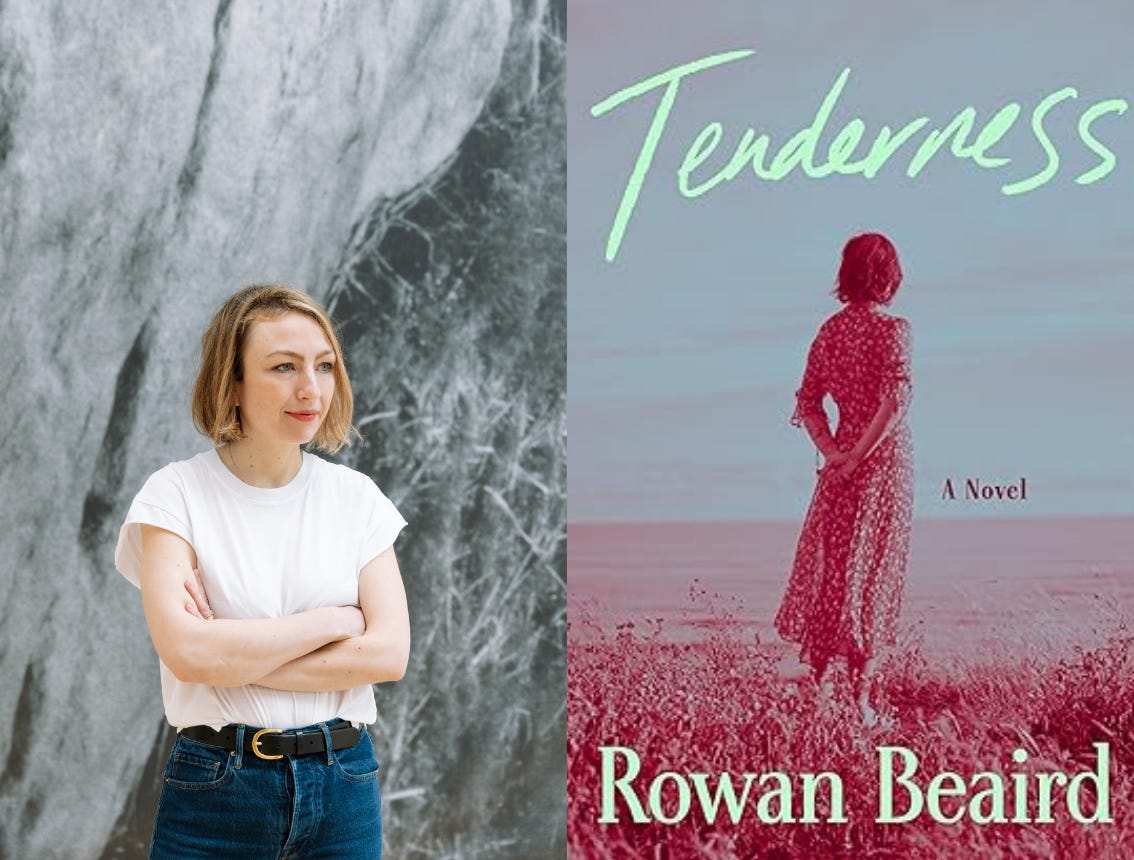
Rowan Beaird
Author
Her latest novel, Tenderness, is available now!
What’s a myth about publishing or being an author that you wish more people understood?
I think a lot of people assume that most writers’ full-time jobs are, well, writing. That is so rarely the case! Even the extraordinarily successful writers I know are also teachers, booksellers, editors, lawyers—the list goes on and on.
When I talk to aspiring writers, I encourage them to think about writing not as a profession, but as a practice. It will almost always be an art you do in concert with something else, and so you need to think about what work can support your writing, giving you both the time and mental space to pursue it as best you can.
When life gets busy, how do you protect your time to write?
I always write early in the morning, before the day begins and gets away from me. I have a full-time job, a daughter and husband, family, and friends, and so life always feels hectic, but when I wake up early, when it feels like most of my world is still asleep, there are no interruptions and no excuses. That time is really sacred to me.
I wrote a book for querying authors…
Get all of my tips and see stats from 4 million real queries

What is the most memorable writing tip or technique that you have heard, and how did it influence your process?
I took a workshop with Lauren Groff—a writer who can do no wrong, in my opinion—and she recommended writing by hand. As a result, I wrote the entirety of Tenderness in a notebook.
There are so many studies that reinforce how writing by hand sparks more brain activity; it connects deeper to memory and stimulates more complex thinking. I believe all of that is true, but for me, it’s meaningful because of what it shuts out. There’s no internet, no text notifications, and no music. It allows me to be wholly immersed in the story I’m trying to tell.
What’s one thing you do (creatively, mentally, or physically) that helps you stay in it when writing gets hard?
In an interview, Ian McEwan shared that he doesn’t believe in writer’s block, but he does experience creative hesitation. I like that choice of language, because a block feels out of my control—something solid, impenetrable in my path—but hesitation means that there’s something in the work giving me pause.
I’m choosing to take a breath. In those moments, I like to take detours. Jump to another point in the narrative, or even write a paragraph about a moment in a character’s past that you’re not sure makes any sense to include in the book. You just want to find some place where there’s heat, to remind yourself what that feels like.
Ready for feedback that takes your story to the next level?
“After I revised my book with your great feedback, I obtained multiple offers of rep very quickly, within the first few weeks, even though I was extremely selective and only queried 16 agents in total! We are currently out on submission!”
—Cindy R. X. He, author of Perfect Little Monsters and This Is Where We Die
What do you do to stay true to yourself in your writing?
I remind myself that trends change and that there is no formula for success.
Publishing is a business, so people will always be speculating about what genres are dead, whether anyone will read a short story collection, and if a book over 100,000 words will sell.
But books take a long time, so the idea of capitalizing on any zeitgeist is absurd to me! The only thing you can control as a writer is whether you love what you’re working on, and if you do, that will never be time wasted.
ICYMI… last week on YouTube, I share what “upmarket fiction” really is, and how to tell if you’re writing it.

This article made me depressed. Just how low creative professions have fallen that to be creative you also need a “real” job.