

Novelists should learn from TV writers.
TV writers’ rooms are chaotic, high-pressure environments where scenes get rewritten on the fly. There’s no time to wait for inspiration to strike. There’s no perfect writing setup. You just have to figure the story out, wherever you are, whenever you can.
And it turns out, that mindset is exactly what novelists need too.
Because waiting for perfect conditions is what keeps most writers stuck.
Train yourself to not need the perfect desk setup, the uninterrupted four-hour block, the wave of creative energy. It might be the single biggest unlock for your writing career.
In today’s interview, author Amanda Pellegrino shares the TV writers’ room lesson that reshaped how she drafts, the “never end on a blank page” trick that keeps her momentum going, and what her unconventional querying journey taught her about publishing.
OUR SPECIAL GUEST TODAY IS…
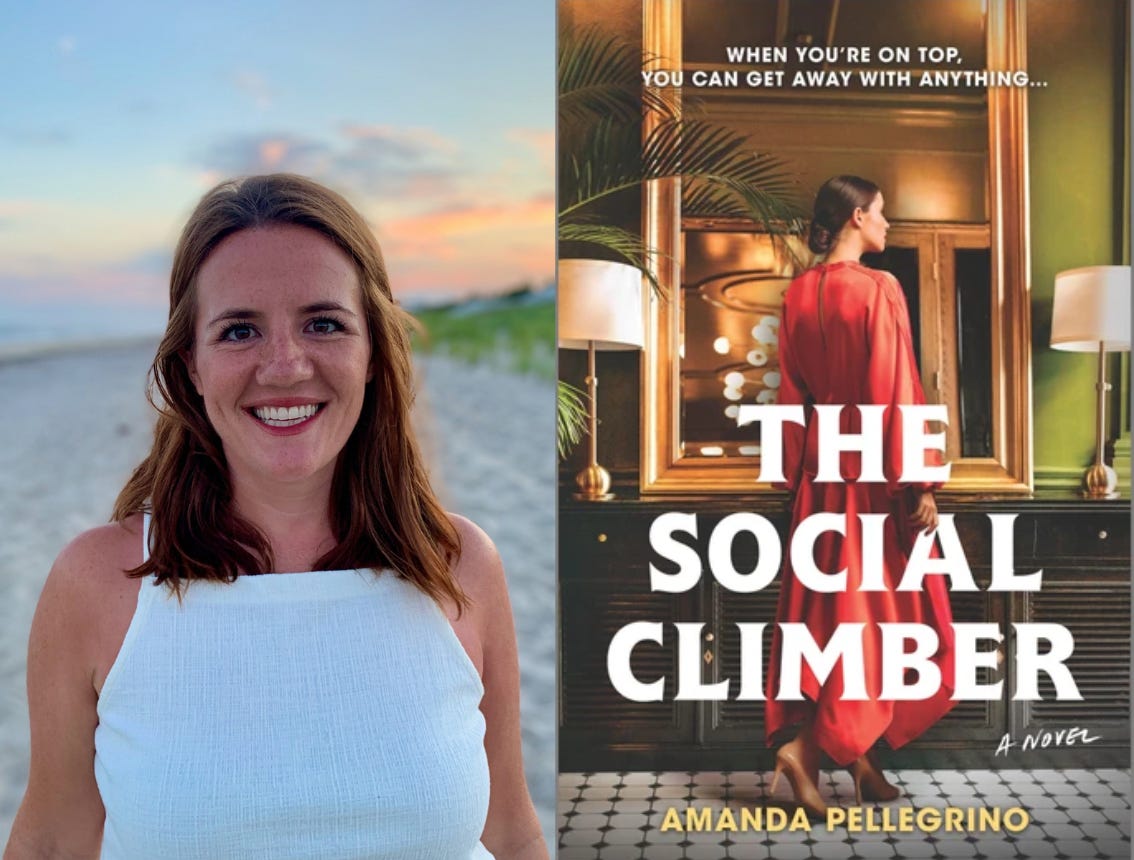
Amanda Pellegrino
Author
Her latest novel, THE SOCIAL CLIMBER, is available anywhere books are sold.
What is the most memorable writing tip or technique that you have heard, and how did it influence your process?
Learn to write anywhere. Before I started writing novels, I was working in TV writers’ rooms, where you learn pretty quickly that you have to be able to do the job anywhere—in a car before rehearsal at 6 a.m., sitting on the curb of a street at noon, on random bleachers at midnight. Scenes need last-minute edits, and you have to be able to make those edits wherever you’re shooting that day.
That trained me to be able to write anywhere, which became incredibly important when I was writing my second book on deadline while producing a TV show in Pittsburgh. I wrote that book in 20-minute sprints, literally wherever I could find a place to put my laptop.
If you can train yourself to write anywhere, you eliminate a lot of the procrastination that comes from waiting for the perfect conditions—the perfect chair, the perfect temperature, the perfect cup of coffee. It teaches you to take advantage of whatever time you have and put words on the page, no matter what.
Sponsored by ProWritingAid

Get your draft ready before your editor sees it with 50% off ProWritingAid this Black Friday.
Finished a draft but not sure it’s good enough? Friends and family loved it, but that doesn’t tell you what to fix.
ProWritingAid, the writing toolkit for storytellers, has 25+ line-editing reports that point to the sentences that need work and explain why. One finds the extra words that slow your sentences down, another spots the words you use too often, and another shows where your pacing starts to drag.
ProWritingAid doesn’t write or rewrite your story for you. It helps you identify what needs work, so you can make every editorial decision yourself. Your voice stays yours, your work stays yours, and your writing is never used to train AI models.
From November 16 to December 4, get 50% off Premium and Premium Pro, on yearly and lifetime plans.
When life gets busy, how do you protect your time to write?
I always have something to write with—my computer, my notebook, or the Notes app on my phone. As long as I have something to write with, I will always find time even on the busiest days to do it. While I love an uninterrupted two- or three-hour writing session, I’ve learned that’s not always going to be the case, so it’s important to use whatever time you have, whether that’s 20 minutes in between takes or five minutes while I wait for the oven to warm up.
What’s one thing you do (creatively, mentally, or physically) that helps you stay in it when writing gets hard?
I try to always end a writing session in the middle of a scene—or sometimes even in the middle of a paragraph. I find that the hardest writing happens when you’re staring at a blank page or starting something completely new, whether that’s a new idea, chapter, or scene.
So I try to make sure I never leave myself with a blank page. If I stop in the middle of something, I know exactly where I’m starting when I sit down again, which makes it much easier to get back into the work. I’m also much more likely to look forward to writing when I know exactly what I’m sitting down to do.
How did you get your literary agent? What was the querying process like for you?
I’ve had a somewhat unconventional path when it comes to finding my agents. I wrote a novel before my first published book and queried it for about six months without any significant bites. During that time, I was writing SMILE & LOOK PRETTY, which would become my first published novel. When I finished the first draft, I sent it to my top few agents. Based on how long it had taken agents to respond to my previous submission, I figured I’d send it out and edit it while I waited. (Definitely not recommended!)
Within a few hours, I had three full requests, and within a week, I had offers on the book. I was shocked. But something about this novel struck a chord—it felt like a novel that only I could write.
After many years and two traditionally published books, I made the very difficult decision to part ways with that agent. With two books and plenty of industry connections under my belt, I got back on the querying train, and...it was much harder the second time around. In fact, it made me realize just how lucky I’d been with my first experience. I say this just to remind everyone that every single querying journey is different — don’t get discouraged if someone’s path looks different than yours. After a few months, I found my new agent, and I’m thrilled to be working with her on everything I have coming down the pipeline.
Ready for feedback that takes your story to the next level?
“After I revised my book with your great feedback, I obtained multiple offers of rep very quickly, within the first few weeks, even though I was extremely selective and only queried 16 agents in total! We are currently out on submission!”
—Cindy R. X. He, author of Perfect Little Monsters and This Is Where We Die
What’s one thing about the publishing process no one tells you, but should?
You have to learn the business side of publishing. I had a mentor tell me very early on that once you sell your art, it’s not just your art anymore—it’s a business. You want to make money from it, your publisher wants to make money from it, and sometimes that means making sacrifices or decisions you might not make if you were thinking only as an artist.
That’s why it’s so important to surround yourself with the right team—your agent, editor, publicist, marketing team, and everyone else involved in bringing your book into the world. There are plenty of times when I defer to someone else’s expertise because I know how to write, but my marketing team knows how to position a book better than I do, my editor knows the market than I do, and my cover team knows how to make a book stand out on a shelf better than I do.
Understanding that you’re running a business — and knowing when to trust the people who are experts in that business — can make a huge difference in the success of your book.