

Hi authors,
Wow. Your messages and posts this week have been absolutely incredible. I’ve never felt so supported, and it means everything to me!
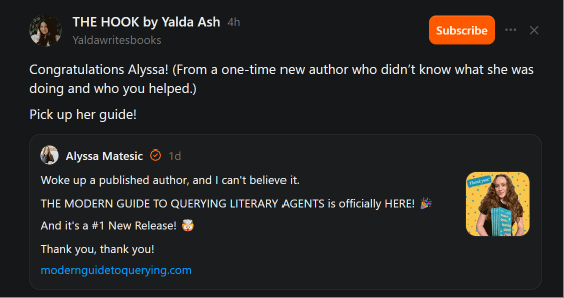
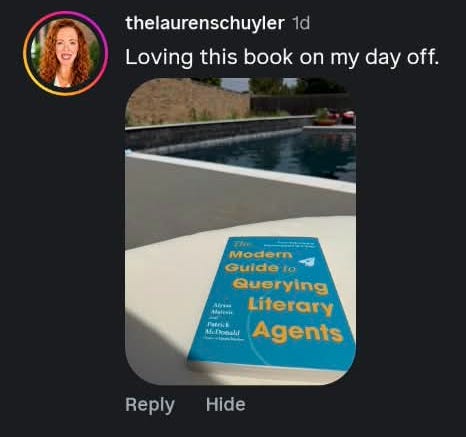

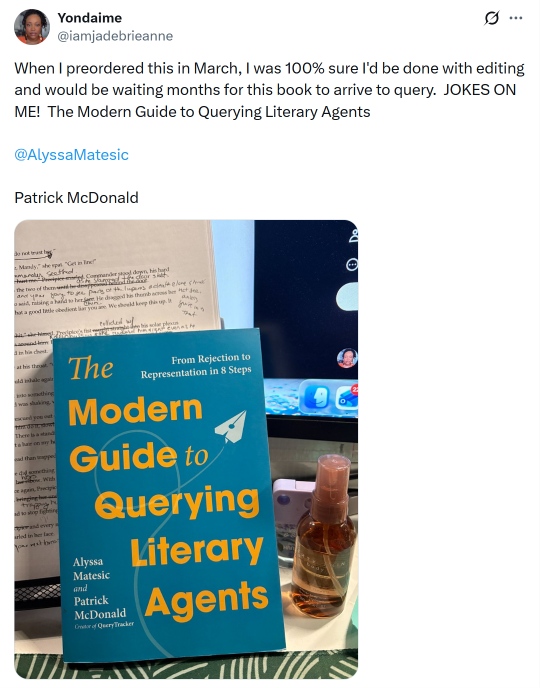
The best part has been seeing photos of The Modern Guide to Querying Literary Agents on your desks, in your cars, with you on your off days — that’s exactly what Patrick and I hoped for.
I know many of you are gearing up to query (or send out a fresh batch of queries) after Labor Day, so let’s make sure your letter is top-notch.
It’s Day 4 of Query Prep Week, and today we’re tackling the part of the query letter authors dread most:
Comp titles.
I promise, they’re not as difficult as you think!
Your fourth lesson: avoiding common comp pitfalls
I’ll often hear authors bemoan that there are simply no comp titles for their book because “nothing like this has ever been published before.”
They think this is a good thing, that it means their book is incredibly unique and special.
But it’s actually missing the point.
Comps are meant to illustrate to an agent — and your eventual publisher — that there is market and reader demand for your book.
So if you’re saying there are no comp titles, you’re saying there is no market for it. That’s not what someone looking to invest in your book wants to hear.
Agents need to picture the reader who will pick up your novel, the shelf it sits on, and the editor they’d send it to. Good comps are how you paint them that picture.
Yes, this means you will probably need to research (and read) recently published books in your genre if you’re not already familiar with them. But this will be time well-spent, because you’ll be learning about the publishing segment that you’re looking to enter.
Your Day 4 assignment
I want you to identify five potential comp titles — you aren’t going to use all five (I recommend 2-3 max), but you want to widen your options in case some don’t end up being a good fit.
Now run each one against the following criteria:
✅ Published in the last five years. You want comp titles to reflect the current book market and reader demand. Recency is one of the most important comp qualifications — and too-old comps are something an agent will immediately spot. That means do not use classic novels as comps!
✅ In your genre and age category. If you’re writing an adult thriller, don’t comp to a YA thriller or an adult fantasy novel (unless you have very good and clear justification). Comp to other adult thrillers — there should be plenty of novels in your genre for you to explore.
✅ Traditionally published. You’re querying literary agents because you want to be traditionally published, so the comps you use also should be traditionally published rather than self-published. If you’re unsure, check the publisher’s name listed on Amazon.
✅ Successful, but not a phenomenon. Skip all mega-bestsellers. Gone Girl and The Hunger Games aren’t realistic comps (plus they’re too old at this point), and highlighting them in your query letter may suggest that you don’t know any books beyond the huge mainstream hits.
For the comps that meet all of these criteria, the next step is to figure out what exactly your book shares with each one.
Read (or at least read a substantial portion of) each finalist and ask: What about this is similar to my book? What common ground would a reader notice across both stories?
It might be the structure, the tone, the setting, the voice, a character, or the theme. Make sure to mention that specific element in the query letter so the agent understands why you chose that comp. (If you can’t find any shared elements or it feels like a stretch, take that comp out of the running.)
Check out our never-before-seen querying data
Our book gives you an insider look into what actually works when querying:
📈 What percentage of successful query letters contained comp titles
📈 How many new clients agents sign on average per year
📈 Real data on agents’ average response times from millions of queries
📈 How many queries authors sent before getting an offer of representation

Tomorrow is the final day of Query Prep Week — where we’ll put together the final missing piece of your query letter so you’re ready to send it out!
Happy querying!
Alyssa
This is exactly it. I think authors like me think that what hooks an agent is the premise and pitch. But we’ve first got to convince an agent that there’s a market for the book before we dazzle them with a premise. And that depends on showing that our book is similar to others that have been published recently—not so wildly different that the agent can’t visualize an audience. Because then an agent won’t be able to convince an editor of the same, which is the biggest part of their job. Thanks for this helpful advice!
This is so helpful, especially your explanation of what exactly comp titles are meant to communicate! I have a question about choosing among the potential comps I come up with. I recently saw a debut deal announcement for a book that has many similarities to mine. On a deeper level they seem pretty different, but the deal mentioned the same two comp titles I was planning to use when I query. Do you think it would be a good idea to go with different ones so my book stands out more, or is it just a sign that I did well pinning down my potential market? Am I just overthinking this??