

Sometimes rejection is really just redirection.
Getting rejected by nearly a hundred agents on your first book sounds like a writer’s nightmare. But for this author, it was actually the beginning of something much bigger.
Once she figured out the problem with her manuscript running underneath all those rejections, she launched a second career as a writing teacher, a bestselling craft book, and an online writing school that’s helped thousands of authors finish their novels.
She had to uncover what her story truly was.
So that feedback that stings the most…might actually be exactly what you need to hear to find your real story.
In today’s interview, author and writing teacher Jessica Brody shares the pile of rejections that redirected her whole path, the “accelerator and brake” analogy that transformed how she drafts, and why getting stuck might be the best thing that happens to your book.
OUR SPECIAL GUEST TODAY IS…
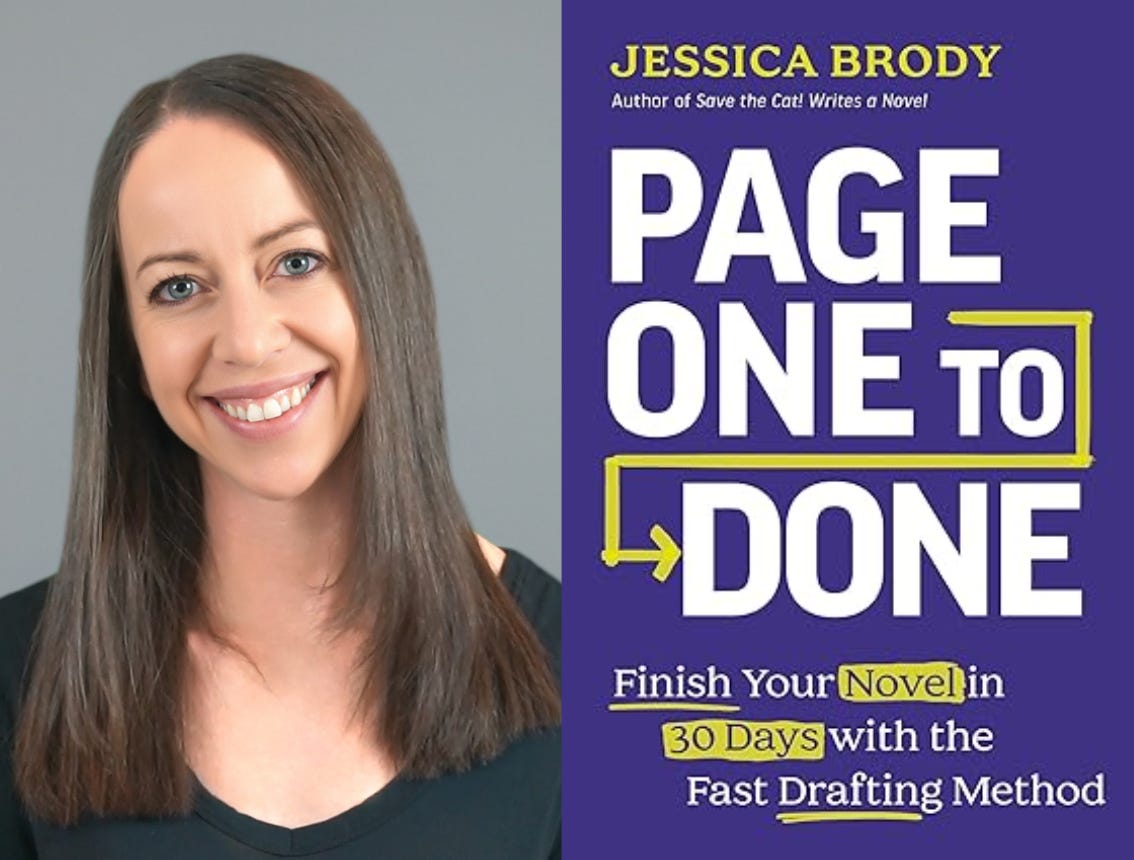
Jessica Brody
Author and Writing Teacher
Page One to Done, available now!
What’s the best piece of feedback you ever received? How did it change your story?
The best piece of feedback I ever received was actually a series of rejection letters that didn’t just change my story…they’re the reason I became a writing teacher.
The first book I ever tried to get published was rejected all over town—by nearly a hundred literary agents. But interestingly, the feedback was very similar: “You have a good voice, but there’s no story here.” At the time, I didn’t even understand what that meant, because I didn’t really understand what a story was.
Eventually, I found a book called Save the Cat! a screenwriting guide by Blake Snyder that broke all movies down into the same 15 story beats. But I quickly realized that the structure could apply to novels too. Not just screenplays. So I rewrote my entire book using this 15-beat method and the revised version landed me my first literary agent who sold the book to St. Martin’s Press. I’ve since written and sold over 20 novels to major publishers, all written with the same method.
But here’s the twist I didn’t see coming: I set out to be a published author. And in doing so, I discovered a screenwriting method that I realized might help other authors too. So I started teaching it in live and online workshops…and that eventually led me to write Save the Cat! Writes a Novel…and launch an online writing school, and now release my latest craft book, Page One to Done.
In the end, that pile of rejection letters led me to the two biggest joys in life: writing novels, and helping other writers write theirs.
What is the most memorable writing tip or technique that you have heard, and how did it influence your process?
When I was on tour with a bunch of really talented authors, including Emmy Laybourne, she said something on a panel that planted a seed that eventually grew into the method at the heart of my book, Page One to Done. She said, “When writing a first draft, don’t drive with your foot on the accelerator and the brake at the same time. You’ll stop and start and go nowhere.”
It resonated because for the first half of my career, writing a first draft was an overwhelming, tediously slow, painstaking process, filled with self-doubt and perfectionism, and I always felt like there had to be a better way. What Emmy said planted an important seed in my mind: I’d been trying to write the first draft and revise it at the same time. Which was as frustrating as trying to drive with my foot on the accelerator and the brake.
Drafting and revising, I soon figured out, are two different jobs that require us to be two different writers. Trying to do them both at once is draining and overwhelming because we can’t do both effectively at the same time. This realization not only transformed my own first draft process, it eventually grew into my Novel Fast Drafting method, which is designed to bring speed, efficiency, and joy back into the first draft process. I put Emmy’s quote in the book as a tribute to her, and it’s still advice I come back to in my own writing daily.
Are you querying this year?
Preorder my book written with the creator of QueryTracker!

What part of the writing process brings you the most joy?
Honestly, it’s the epiphanies. When I’m stuck on a plot problem, or backstory that isn’t working, or two subplots I can’t seem to connect, there is nothing more joyful than finally coming up with the answer (usually from walking around my yard talking to myself!) It’s a moment of pure creative discovery. And what’s ironic is that you actually have to get stuck first to experience it.
If we sat down to write a novel and everything came out finished and perfectly worded, with no plot holes and no stumbling blocks, I think that would actually be really boring. For me, the joy is in the discovery. The twists and surprises I hadn’t thought of when I started, the deviations from my outline, the aha! moments when things finally come together. But to experience that joy, I first have to get stuck.
So that’s a reframe I’ve taken to heart and one I encourage other writers to try: the next time you get stuck, try not to think of it as a “problem.” Try to think of it as an opportunity to discover something new and surprising about your story—and maybe even about yourself as a writer. See if that unlocks a little more joy in the process.
What’s one thing you do (creatively, mentally, or physically) that helps you stay in it when writing gets hard?
One thing that’s been a huge unlock for me over the past few years is brainstorming aloud. It originated when I wrote a trilogy with a co-writer and we had to brainstorm out loud, so I got used to speaking my thoughts. Now, whenever I’m stuck on a story problem (whether it’s in the first draft or the fourth) I take out my recording app, walk around my yard, and just talk aloud. I lay out the problem, experiment with different angles, and play out scenarios: “what if I do this, then that happens, but what if I went this way instead?”
There’s something about writing an idea down that makes it feel permanent, like I’m committing to it. But when I just talk aloud, it releases that need to have the right answer, and that frees up my creative brain to actually find one. Nine times out of ten, I end up with an answer by the end of the brainstorm. But even when I don’t, the process itself primes my subconscious to keep thinking about it throughout the day and eventually the answer appears (usually when I first wake up the next morning!) So on hard writing days, you’ll often find me walking in circles in my yard, talking to myself. (I have no idea what the neighbors think!)
Ready for feedback that takes your story to the next level?
“I have greatly benefitted from my collaboration with Alyssa; I would not be where I am today without her! Her developmental ideas and vision for my novel taught me so much and helped to elevate my work in highly effective ways. Her editorial fingerprint is evident in the final result—a novel on bookshelves nationwide.”
—Jill Beissel, author of Glitter and Gold
When life gets busy, how do you protect your time to write?
I learned early on that if I don’t make writing a priority, it easily slips through the cracks. That’s why I always do it first. No matter what. Even if I have an 8 am meeting, I wake up at 6 so I can get my words in.
The truth is, the more we pack into our day, the less mental energy we have left over to do the thing we want to do (which I’d venture to guess for most of us is writing!). I call this mental energy “cognitive currency.” And research has shown that deciding whether or not to write can actually spend more currency than doing the writing itself. So I take that decision off the table: I write first, before I do anything else. I don’t open my phone, a browser, or my email until my writing is done.
It was hard at first, because I used to wake up and check Facebook, Instagram, my sales ranks, email, and whatever else I could think of! Then, by the time I sat down to actually write I was drained. To break this habit, I started sleeping with my phone in another room, so I would be less tempted to look at it first thing. Whenever I was tempted to look at it, I’d ask myself: “Jessica, do you want to be a professional Instagrammer or a professional writer?” The answer was always writer.
I find that by simply being more intentional and protective of where I spend my cognitive currency, I can reserve enough for the thing that really matters to me…even on the busiest of days.
ICYMI…this week on YouTube, I’m talking about the viral claim that it costs $25,000 to get a literary agent. Is it true?

I've sent 30 queries so far, and most of them come with a nice notes saying something like, 'I know you will find the right agent' or 'I really considered it, but it wasn't a fit for me'... So at least they are reading the letter and the first few (whatever they requested in QT). I'm trying to stay positive.
I feel you, Jessica! It was sometime in earning a BA in English that I learned about the 8-point arc, so I made a YouTube video tutorial using The Hunger Games as an example. I really have no idea why I never applied this structure to my own novel. After 100+ form rejections from agents, I finally realized, hey, maybe I should use my own video to structure my novel. My editor gave her blessing on my new outline, and I'm rewriting the entire thing right now.