

Many authors’ first manuscripts don’t get published.
It might take years — and multiple abandoned manuscripts — before you write the novel that lands you an agent and book deal. That’s OK.
That doesn’t mean your first novel wasn’t worth writing. Going through that process teaches you so much about the craft and about yourself as a storyteller.
So love the process, not the outcome.
You have a rare gift: You get to create worlds and characters that never before existed. You get to move people through your words. And whether or not this project is the one that you’ll see on the shelves at your local bookstore, it’s still worth getting down on the page.
In today’s interview, New York Times bestselling author Patrick Ryan shares the four-decade journey behind his debut, the mindset shift that kept him going when publishing felt out of reach, and the daily practice that helped him finally finish the book that changed everything.
OUR SPECIAL GUEST TODAY IS…
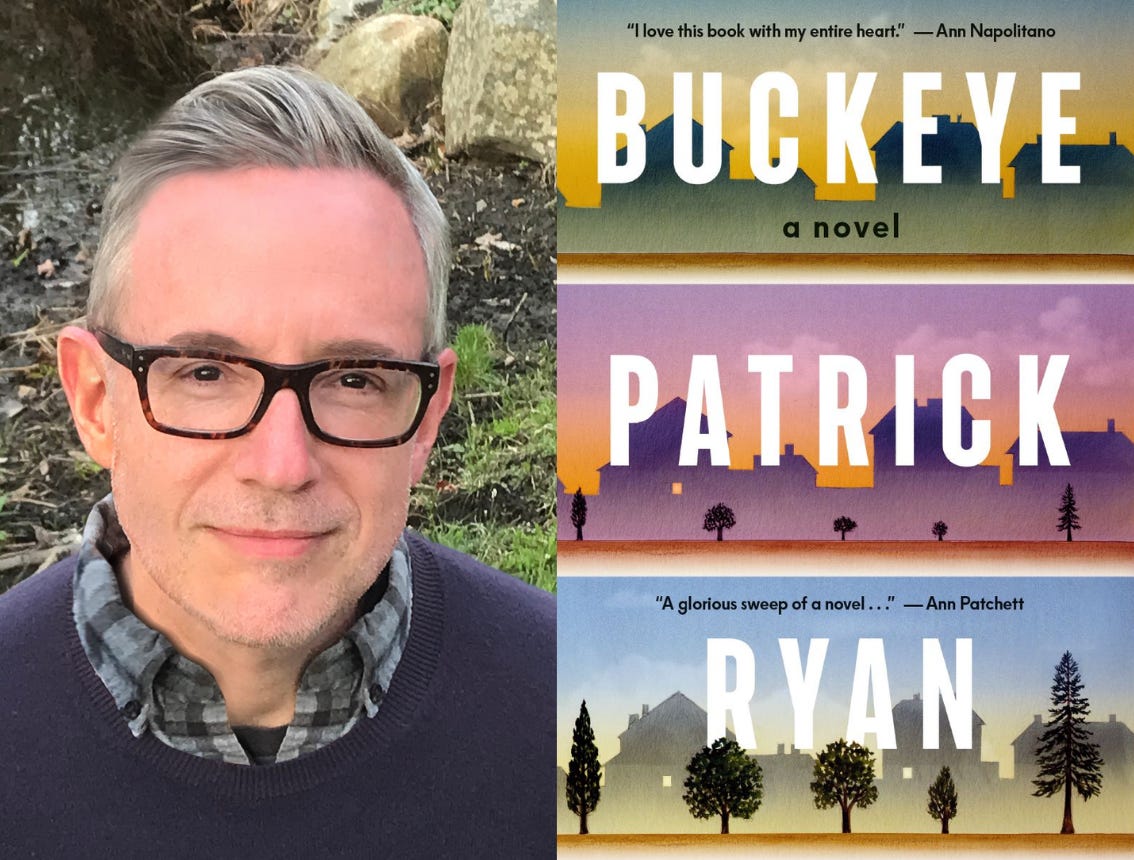
Patrick Ryan
New York Times bestselling author
BUCKEYE is out in paperback now!
What’s been the toughest moment in your publishing journey, and how did you get through it?
The toughest moment in my publishing journey lasted forty years. I wrote my first novel when I was 21, and while I worked dozens of different jobs (teaching, house-painting, bartending, retail, etc.), and worked on short stories, I was always working on one novel after another — and I couldn’t find an agent or a publisher for them.
I have, I think, seven finished novels sitting in a drawer, and around eight that I got a third to halfway through before abandoning. They were all practice and will never see the light of day. I kept doing it, hoping I was getting better as I went. But it was tough to keep going, at times, because I couldn’t help but think I wasn’t ever going to be “good enough.”
When I started BUCKEYE, I had no reason to think I’d be able to publish it. But by then, I’d come to the conclusion that all this novel writing couldn’t be about publishing (since that was out of my control). It had to be about the writing itself, and the fact that I enjoy doing it. I worked on BUCKEYE for eight years, and it came out just after I turned 60.
So I got through my doubt by letting go of the prize I didn’t have (a published novel) and embracing the one I had (the joy of writing).
What is the most memorable writing tip or technique that you have heard, and how did it influence your process?
When you’re writing a novel, spend some time with it every day, even if that’s just for a half-hour (even fifteen minutes). Don’t stay away from it just because you don’t have adequate writing time that day. If you can’t write, you can reread, and that will keep the novel in your head as you go about the rest of your life.
This was a game-changer for me. It helped me feel ready to write on those days when I actually had time to do it!
I wrote a book for querying authors…
Get all of my tips and see stats from 4 million real queries

When life gets busy, how do you protect your time to write?
Only by spending at least a little time with my project every day — even if that’s just a few minutes of rereading. That’s not protecting my writing time, but it’s protecting my project (from dying of neglect while I’m doing other things).
What’s one thing you do (creatively, mentally, or physically) that helps you stay in it when writing gets hard?
Stretch in the morning (especially my back and legs). I have a routine that takes just as long as it takes for my espresso maker to make a pot of coffee.
Ready for feedback that takes your story to the next level?
“Wow! I’d racked up more than 40 rejections when I reached out to Alyssa, and she quickly helped level up my querying game. Thanks to her help, I got multiple requests from agents. Some of those requests turned into offers, and I now have representation!”
—Susanna Jech Paul, women’s fiction author
What part of the writing process brings you the most joy?
Editing. I write on a computer, print a chapter or a chunk of pages after I’ve spent a lot of time with them on-screen, anchor them to a clipboard, and use a red pen. I’m ruthless, and every page gets messy with red ink. Then I enter all those edits back into the computer, reprint, and do it again, and again, and again. I find it very enjoyable to see the work on paper and to edit by hand.
What’s the best piece of feedback you ever received? How did it change your story?
Not every scene needs an arc — a beginning, middle, and end. A scene can just be a few minutes, or moments. A scene can be a fragment.
I'm 60 now so I can't wait 40 years to get my debut novel published! But publishing would be the icing on the cake. The cake itself is what's important. I loved the process and art of writing. I wrote it by hand (almost all of the 650 pages ) and loved the physicality of doing it by hand (not with my Mont Blanc fountain pen sadly, but my Kindle Scribe was close enough) as well as the creativity I feel this enabled. I loved the way the act of writing ended my brain in areas it doesn't go in my normal working life. It was addictive.
Now I know I'm a writer. I'm just not a published author. Yet!
i love it